
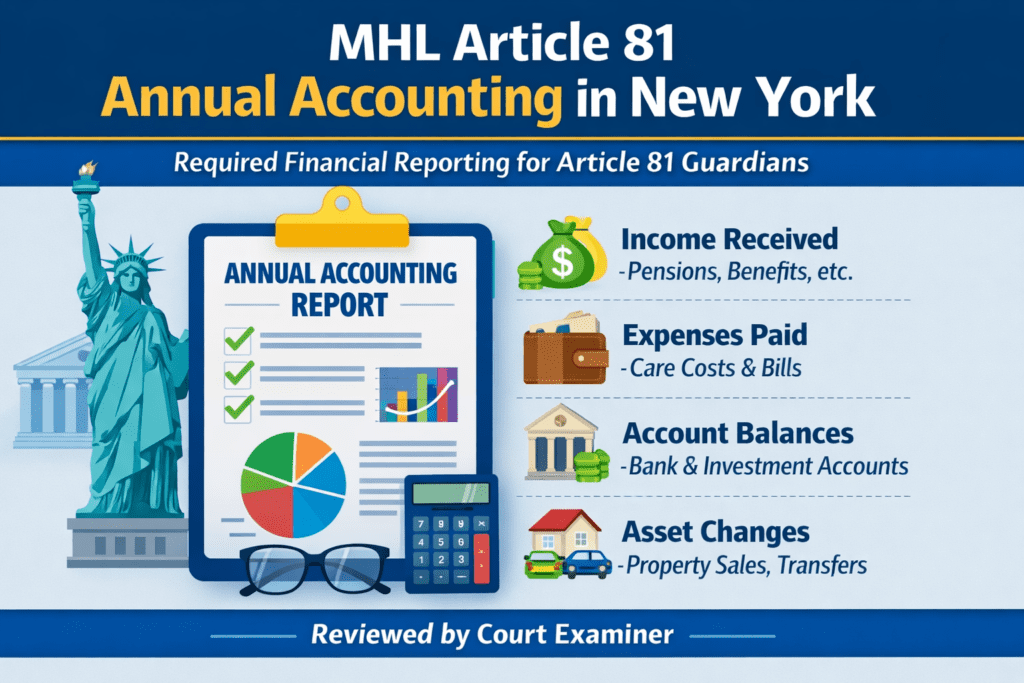
Article 81 Annual Report vs. Annual Accounting in New York: What Do Guardians Actually Have to File?
If you are a guardian appointed under Article 81 of the New York Mental Hygiene Law (MHL), you may hear two different phrases used for yearly filings. The filings are commonly called and “annual report” or “annual accounting.”
Here’s the key point—both terms can be correct, depending on what part of the filing you are talking about.
Under MHL § 81.31, the statute requires an annual report.
But for guardians with property management authority, that annual report must also include detailed accounting-style financial information—which is why lawyers, courts, and guardians often refer to it as an “annual accounting” in practice. MHL 81.31 requires that the annual accounting be in the form required by the Surrogate’s Court Procedure Act.
This article explains the terminology clearly, why different terms are used, and what to do if you’re unsure what the court expects.
Quick Answer: “Annual Report” Is the Statutory Filing—The “Accounting” Is Inside It
Think of it like this:
-
Annual report = the overall yearly filing required by Article 81.
-
Annual accounting = the financial/accounting portion of that annual report (especially when the guardian manages property).
So, it’s not simply that “some people call it one thing and some call it another.” The statute uses annual report, while also requiring accounting-level financial detail within the report for property management matters.
Article 81 Annual Report vs. Annual Accounting
Article 81 requires every guardian to file an annual report (generally due in May, unless the court orders otherwise).
If the guardian has property management responsibilities, the annual report must include information required for an annual accounting (accounting-style schedules and supporting detail).
After filing: Annual reports are examined to evaluate the person’s care, finances, and the guardian’s performance; incomplete or missing reports can trigger demands and possible court action.
What Is the Guardian Annual Report in New York?
The annual report is the yearly status report that Article 81 requires guardians to file. The statute lists categories of required information, including basic contact/residence information, updates about the incapacitated person’s condition and care, and other activities the guardian performed.
Article 81 also imposes reporting duties as part of a guardian’s core obligations.
What Is the “Annual Accounting” Part?
If you are a guardian of the property (or have financial/property powers), the statute requires the annual report to include property-management information in an accounting format—it references the form of papers required for annual accountings.
In plain English: the court is looking for where the money came from, where it went, and what remains, with enough detail to verify it.
This is why you’ll often hear people say “annual accounting,” even though the statute calls the overall submission an “annual report.”
Why You Hear Different Terms
1) The statute vs. courtroom shorthand
The law uses annual report, but the most time-consuming piece for many guardians is the accounting-style financial section. “Annual accounting” becomes the shorthand term.
2) Different guardians have different powers
Article 81 appointments can involve:
-
Personal needs powers,
-
Property management powers,
-
or both.
When a guardian has property powers, the accounting components become central.
3) Court review is tied to financial oversight
The court examines annual reports to determine the finances and how the guardian carried out duties. The court can require revisions or proof of items.
That review process pushes everyone toward “accounting” language because the financial documentation is what usually drives examiner questions.
What Happens If You File the Wrong Thing (or Leave Out the Accounting Detail)?
If the report is missing or incomplete, the court examiner can demand that the guardian file the report or provide a revised report/proof—and the court may deny/reduce compensation or remove the guardian in some circumstances.
Even when there’s no wrongdoing, missing records, unclear transactions, or incomplete schedules can lead to:
-
Deficiency notices,
-
Requests for revisions,
-
Delays in approval,
-
and sometimes a court appearance.
Practical Tips for Article 81 Annual Accounting
-
Keep a dedicated folder (digital or paper) for bank statements, receipts, and major transactions.
-
Avoid mixing funds—keep accounts clearly titled and separated.
-
If you’re unsure what your judge or court examiner expects, follow the court’s prescribed form and your order of appointment, and ask before filing.
Related Resources
For a more detailed breakdown of what guardians typically need to assemble for the financial portion, see:
MHL Article 81 Annual Accounting: What Guardians Must File in New York
https://probatelawyerli.com/mhl-81-guardian-annual-accounting-new-york/
For a detailed explanation of the step by step process to become an Article 81 Guardian:
How to File an Article 81 Guardianship in Suffolk County, NY (Step-by-Step)
Help With Article 81 Annual Reports and Accountings in Suffolk and Nassau County
If you are a guardian in Suffolk or Nassau County and need help preparing, correcting, or responding to questions about your Article 81 annual report (including the accounting portion), experienced legal guidance can make the process much smoother.
Learn more about Article 81 guardianship representation:
https://probatelawyerli.com/guardianship/
Contact us to discuss your situation:
https://probatelawyerli.com/contact-us/